Presenting a new (and
now, continuing) series of posts where I share some intermediate-to-advanced
scorekeeping methods and tips. The
assumption here is that you’ve already made it through “Scorekeeping 101” and
are working out ways to improve your skills and expand your enthusiasm for
scorekeeping. I’m also assuming you are
using the current version of my customized scoresheet, which you can download
for FREE, as I will use it for all of these examples unless otherwise
specified. Get your pencil ready, the
game is about to start!
In
Part
One of this series, I demonstrated my methodology (and notation) for
tracking pitches during a game using the current version of my customized
scoresheet (you can download it for
FREE
right here). Before we go any further,
it’s important that you revisit what was detailed in that post, as I’m going to
build on that for this topic…how to accurately track
the order of pitches, and do it quickly and easily.

This isn't necessarily ground-breaking stuff, I’m sure, but
I feel it is still rather unique…when I hinted that this topic would be covered
in this installment of the series, I received a great deal of feedback, most of
it consisting of anticipation. When I
developed and practiced my notation, I did so hoping that someday I could use
it to track the pitch order, thereby beginning with the end in mind. It was a process that, very much like looking
for your lost car keys, was a little bit frustrating…trial and error was
confusing, and mostly ending up in the “this is too complicated, and I’ll never
be able to do this real time so it’ll
never work” bucket. I’m happy to report
that the solution was, quite literally, right in front of me the whole time; so
now, I’ll get it in front of you.
For the record, the Project Scoresheet
method allows the scorekeeper to track pitch order to some extent; however, I’m
still digging into this myself, so I’m not ready to discuss that at this point
in time.
As I stated in the previous post, counting pitches is both a
necessary aspect of solid scorekeeping, and a useful tool to support the
recounting of a variety of events within any baseball game. For a variety of reasons, most of them
specific to the scorekeeper’s individual needs, the order of the pitches is a
critical aspect of the documentation process and the data can reveal a great
deal of information that is enlightening and often revelatory in nature.
This is a high-brow
way of saying, when your game announcer proclaims “Volquez is on fire tonight,
he’s thrown 11 first-pitch strikes in 4 innings of work, that’s exactly what
Bud Black is looking for from his starter” you can shower yourself in pride by
exclaiming “YES, I am fully aware of this!!”
A quick recap of the specific areas of the scoresheet that
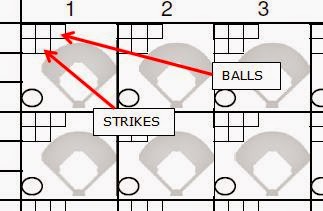
will be used, as well as the previous notation, is in order. Here are the “pitch boxes” found in each
Plate Appearance Box; “balls” upstairs, “strikes” downstairs:
Remember when I casually stated that the intent of the boxes
to be used from left-to-right would be important later? Later is now.
It should be second nature to the intermediate scorekeeper
to start with the first pitch, whether it’s a ball or a strike, in the
appropriate box at the farthest left-hand side.
The order and orientation will help us record the pitches in order, and
be able to interpret the notation quickly.
I’m going to use the same notation previously used, but only in the “strike” boxes. I will no longer use the “forward slash” in
the “balls” boxes, and I also won’t be using the “X” for foul strikes outside the “strike” boxes. Instead, I’m going to use numbers in those areas. HOOAH! NUMBERS!
This is where I wink
at you and chuckle a little bit, I told you this was simple!
This is going to look like one of those Logic Puzzles, where
you are presented with a series of numbers and symbols and are asked to
determine the numbers that are represented by the symbols.
If I asked you to determine what numbers are represented by
the symbols in this series above are, you would smugly reply “3, 5, and 6
respectively.” So far, so good.
The pattern above is not much different than this one:
The symbols are different, but you can also determine that
the two dots are, respectively, 3 and 5; and that the “x” is 6.
Yes, it’s true. 1,2,
4, and 7 are balls – the dots (hinomaru) are called strikes – the “x” is a foul
strike…and they are all in the order in which they appeared!
Pitch #1: Ball (1-0)
Pitch #2: Ball (2-0)
Pitch #3: Called Strike (2-1)
Pitch #4: Ball (3-0)
Pitch #5: Called Strike (3-2)
Pitch #6: Foul Strike (3-2)
Pitch #7: Ball (the batter takes his base)
This is precisely how
I am going to document each pitch, type of pitch, and the order the pitch was
offered without having to redesign my scoresheet, or having to write this stuff
down on a separate piece of paper. While
we are still having the time of our lives, let’s commit this philosophical
approach in a live fire exercise! We’ll
use actual game data from the top of the 1st inning at Louisville
Slugger Field in Louisville, KY where the Durham Bulls’ top of the order is
facing Louisville Bats starting pitcher Pedro Villareal on June 10, 2013. The scoresheet is all set up with the
starting lineups, and we are ready to go!
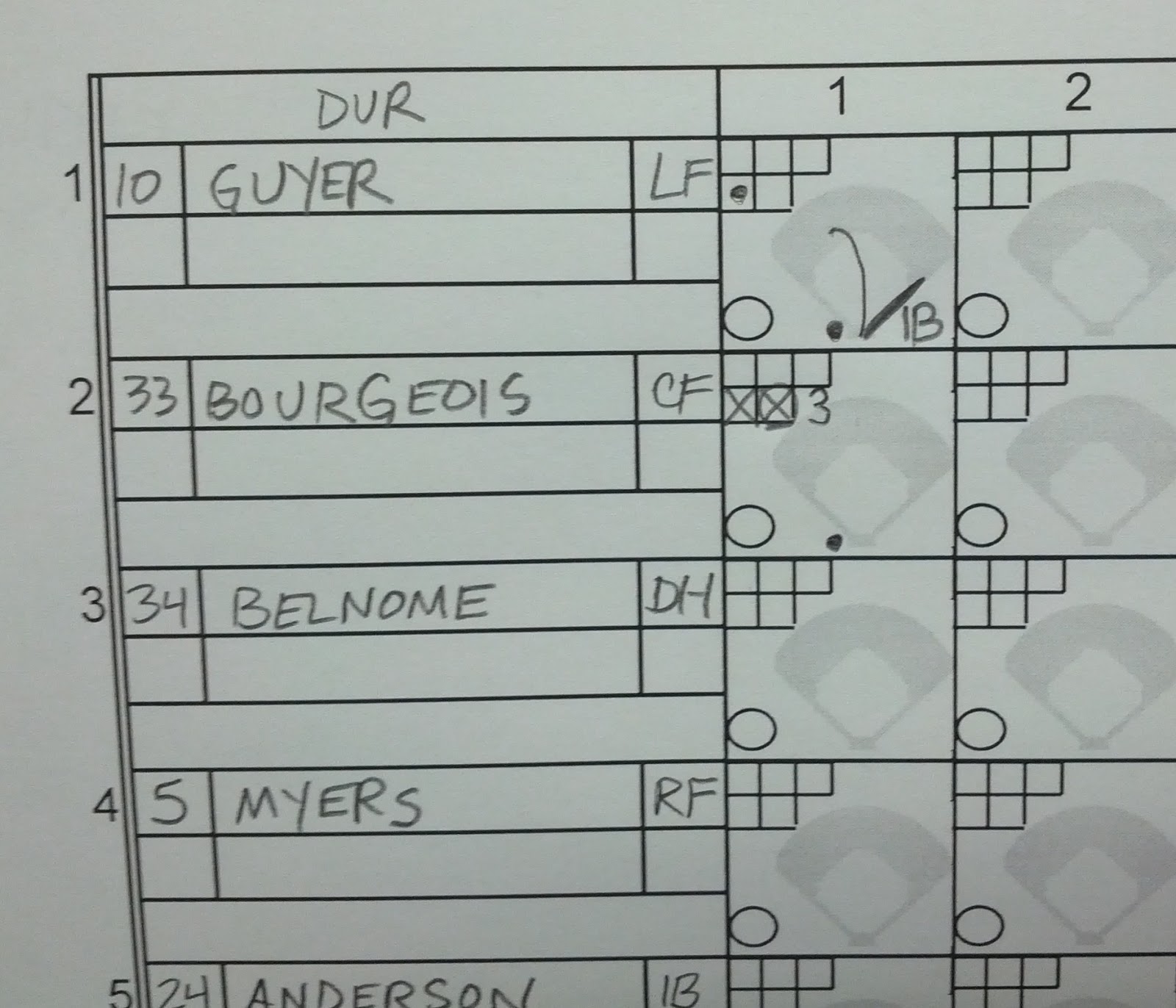
Lead-off batter Brandon Guyer steps into the box, and
Villareal’s first pitch is taken for a strike.
The hinomaru appears in the
first “strike” box on the left, same practice we've been accustomed to. The count is 0-1.
Guyer hits a line drive single to the left of Shortstop
Emmanuel Burriss’ ear holes that drops for a base hit.
Jason Bourgeois is next, he fouls off Villareal’s first
pitch. The “X” goes in the first
“strike” box on the left. The count is
0-1.
Bourgeois shows bunt, and again fouls off Villareal’s second
pitch. The “X” goes in the second
“strike” box from the left, I circled it to indicate a bunt was either shown
and/or executed. バントを指定!! The count is 0-2.
Hang on, here comes
the GOOD STUFF.
Villareal’s next offering (his third pitch of the at bat) if fouled off again. Bourgeois has Pedro’s
number, it seems, but it’s still early.
The count remains 0-2; but I’m not
going to mark an “X” to the right of the second “strike” box as I would have
done before…I’m going to write a number “3” = for the third pitch of the at bat.
Take a moment and look at the graphic data ‘real quick’…3
pitches, 3 strikes, all of them foul strikes, from left to right. Where the “X” was used before, ad nauseum, for each foul strike
recorded outside of the strike boxes,
I will use numbers for them all, and
each of those numbers will correspond with the order of the pitch as delivered.
Why then, is the “X” still used in the “strike” boxes? And
the hinomaru as well? The first two strikes will always be those types of strikes, plus
the swinging strike. The called strike
and swinging strike will never occur
outside of the two strike boxes, only the foul strikes will…therefore, the “X”
notation is assumed for those strikes “outside of the box,” always. Sure, I could keep using them, but then I
will lose count. This will be more
evident as we proceed, but for now think about the simple logic puzzle I
presented earlier. There are going to be
pitches in our sequence where a number
must be indicated, otherwise the puzzle can’t be deciphered quickly and
accurately. The type of pitches in
strike boxes one and two can be any of 3 different types, but outside the
“strike” boxes, and in the “ball” boxes
as well, the type of pitch will always be either a “ball” or a “foul
strike.”
Moving on with Bourgeois’ at bat, Villareal throws outside
for a ball. The count is 1-2; as I just
explained, anything in the “ball” boxes will always be a ball, so the forward slash notation is no longer
needed…it will always be a number, and for this fourth pitch of the at bat, that number is going to be a 4.
Stating the obvious: 4
pitches so far, and the order is strike-strike-strike-ball.
Bourgeois fouls off Villareal’s fifth pitch in the at bat, the count is still 1-2. For this foul strike, the number “5” is
recorded in the area to the right of the “strike” boxes, right next to the
number “3.”
Villareal’s sixth
pitch finds Bourgeois’ bat, as he flies out to right fielder Denis Phipps
to record the first out of the game. The
at bat ends with a count of 1-2, 6 pitches total…we know the types of pitches,
the order in which they were dealt with, and the results are unanimous…this is
great, and it’s easy to document and
interpret quickly!!
Here’s what this would have looked like on the scoresheet,
using just notation and not tracking the order:
It was fantastic to see all of the pitches the way the
notation was used before, but now that the order can be tracked, the “old way”
doesn't really tell the same story. It
can’t be determined that the first pitch of the at bat was a strike, and it
also can’t be determined that the first pitch out of the zone didn't happen
until the fourth pitch. That’s like
hypnotizing chickens!!
The Designated Hitter Vince Belnome, is next, batting third. Guyer is still hanging around on first
base. Belnome steps into the box on the
left-hand side of the plate, and takes Villareal’s first pitch for a ball. The count is 1-0, the number “1” appears in
the first “ball” box to indicate this.
Belnome takes the next pitch for a ball as well, the count
is 2-0. 2 pitches, 2 balls, number 1 and
number 2, from left to right.
Villareal’s third pitch is nodded off by Belnome. The count is 3-0.
Belnome fouls off the fourth pitch of the at bat; I mark
this one as an “X” in the very first “strike” box. The count is 3-1.
Villareal offers something Belnome really likes, he swings
and misses for strike 2. When he does
so, that clever speedster Brandon Guyer swipes second base effortlessly,
without a throw. The forward slash goes
in the second “strike” box; the count is full.
I also notate Guyer’s SB, indicating that it happened while Belnome was
at the plate (SB 34)…because he stole the bag on Villareal’s 3-1 pitch, I add
this detail to the PA box to the right of Guyer’s.
Think about this one
more time. Previously, with the
“ball” boxes full of slashes and the “strike” boxes occupied with an “X” and a
forward slash, all that really told us was that at this point, Belnome worked a
full count here. Now, with the number
notation, a little bit more is known…Belnome actually worked from a 3-0 count
to a full count in the space of two pitches.
Depending on your need and what the scorer does with this information,
that’s a pretty significant change in the story, don’t you think?
Belnome fouls off Villareal’s sixth pitch of the at
bat. Now that we know the order, it’s
clear that Belnome went from passive to aggressive during this plate
appearance! The number “6” is recorded
in the area just outside of the “strike” boxes, as I did during Bourgeois’ at
bat.
I already know that any number there indicates a foul strike
(just as any number in the “ball” boxes indicates a ball) and just as the guy
sitting in the row in front of me says “I wonder how many pitches this guy has
seen?” I blurt out “SIX” because I’m counting them, and I’m counting them with numbers.
Belnome hits a nearly sky-high fly ball to shallow left
field, Felix Perez cradles it for out number two. Seven pitches in that at bat! If you glance at the previous two batters,
and just briefly count the number of marks you've made, you can blurt out that
Villareal has thrown 2+6+7 = 15 pitches in this inning so far, no big whoop…and
you can also blurt out that he’s thrown a total of two first pitch strikes so
far! Nice!!
Belnome also becomes
the first player of the game to bat with runners in scoring position, he’s
0-for-1 in Team RISP…I will cover this in a future post!
The indefatigable future baseball superstar Wil Myers,
batting cleanup for the Bulls, steps into the batter’s box. Ahem.
Guyer is still in scoring position with 2 outs. Myers takes Villareal’s first pitch for a
ball. The count is 1-0, Villareal has
thrown 2 first pitch strikes to 4 batters so far.
Myers fouls off Villareal’s second pitch of the at bat, the
count is 1-1. Again, I use the “X” in
the appropriate “strike” box.
The third pitch: swingandamiss! Myers is behind in the count
1-2. Forward slash in “strike” box
number 2!
Myers lays off the fourth pitch and takes it for a ball; the
number “4” goes in the appropriate “ball” box, the count is 2-2.
This particular at
bat, in terms of count, order, and notation, is probably the best practical
example so far of the way the premise of the simple logic puzzle that started
this discussion works the best…and also proves out its ease of use in this
application. While the document is being
generated, the notation is simple; after the fact, interpretation is just as
easy! You should now be able to look at
the at bat in two different ways: first, as a 2-2 count and second, in the
precise order of events – ball-strike-strike-ball.
Now that Villareal knows what pitches Myers likes the best,
he gets him to swing and miss on the fifth pitch of the at bat to record the
third and final out of the inning.
Myers joins Belnome in
the 0-for-1 with runners in scoring position club, the Team RISP so far is 0-2.
He is also the first player to get a mark in the “Runners in Scoring Position
with 2 Outs” category.
Counting the pitches, as before, Villareal threw 20 pitches
total, 14 for strikes. Of those 14
strikes, 10 of them saw contact. Now, we
know a few more things:
- Villareal is 2-4 in throwing first pitch strikes
- 2 of the 4 at bats ended with a “pitcher’s
count,” which is good for Villareal (even though one of them ended with a base
hit)
- One batter came from behind a “batter’s count”
to work a full count (Belnome), one batter saw 3 strikes before he saw a ball
(Bourgeois), etc
There are a lot more “stories” just from this inning that
can be gleaned from the new order notation, all of them are important but the
very last bullet above is the most significant as the scorekeeper can derive a plethora
of analysis, either during the game or 10 years later, all from this
document. It’s a lot like acquiring a
copy of the Annotated Complete Works of Arthur Conan Doyle; very little detail
is lost in context and external research for this event is intensely minimized.
This certainly isn’t the “final frontier” of pitch tracking
on scoresheets, but this revised method and notation (in my opinion, at least)
covers a larger gap of data substance between simply counting them and counting
them with the order that I was sure was there, but really had no idea until I
tried it and it worked. This aspect of
enjoying the game, for me, has been enriched beyond my personal expectations.
The ease of use and learning curve is also astonishing. After only one trial game, I found myself
slipping into this updated methodology in a more comfortable fashion than I did
when I first started counting pitches altogether. Granted, I had been counting pitches for
several years, but I still believe that the process took hold in my brain so
effortlessly that I still find myself shaking my head in disbelief that I never
thought of this sooner!! After 20-or-so
games of applying this method to counting pitches, I only slipped back to the
previous method one time, and I caught myself doing so during the at bat in
which it happened.
Here are my completed scoresheets for this game in its
entirety, with complete use of this notation, all pitches counted and recorded,
and all pitch order tracked.
I’m certain that you are ready to try this immediately;
however, I want to revisit one treasure box from this updated method very
briefly…let’s take another look at first pitch strikes.
These are from another Louisville Bats game at Louisville
Slugger Field; this time the Columbus Clippers are in town and the remarkable
Tony Cingrani is starting for the Bats.
If you aren’t familiar with Cingrani, he’s a really damn good
pitcher. I wanted to use this game as an
example of how the scorekeeper can readily identify first pitch strikes for
point of discussion or analysis, using the new updated notation technique.


In a matter of a few minutes, I can look at both completed
scoresheets and build whatever narrative I deem necessary from not only the
pitch counts, but the pitch order itself.
Beyond the final score and the lines and who hit a dinger and how many
ribbies what part of the order produced, if you weigh first pitch strikes as
more of a pitcher efficiency exercise and less of an eager-beaver approach by
the batters, there’s a lot going on here. Focusing on pitcher efficiency, let’s start by looking at Cingrani (5
innings) and the rest of the Bats bullpen staff (3 innings) and compare their
efforts in regards to first pitch strikes!
This is how easy it is…any PA box that does not have a number “1” in it, that’s a
first pitch strike! BAM! I don’t even have to think at this point!
I would have to think
about it if the first pitch hits a batter, though…that isn’t a first pitch strike.
Tony Cingrani, first pitch strike percentage = .652
1st: 3-3 (3 total)
2nd: 4-6 (7 total, 7-9 overall)
3rd: 4-7 (11 total, 11-16 overall)
4th: 1-3 (12 total, 12-19 overall)
5th: 3-4 (15 total, 15-23 overall)
Mike MacDougal, first pitch strike percentage = .166
6th: 1-3 (1 total)
7th: 0-3 (1 total, 1-6 overall)
Chad Reineke, first pitch strike percentage = .444
7th: 2-2 (2 total)
8th: 1-3 (3 total, 3-5 overall)
9th: 1-4 (4 total, 4-9 overall)
MacDougal and Reineke are easy to compare, both having faced
less than 10 batters but more than 5. Cingrani’s
results are awesome, even without a textbook for comparison. I don’t have a baseline metric for what an
optimal first strike percentage is, for relievers or for starters, but with enough completed scoresheets in hand
with this type of notation, and perhaps some data on WARP and FIP to do some
on-the-fly correlation, think about the possibilities of expanding this data
just for yucks!! I love it!
The Bats beat the Clippers 5-2, Cingrani got the W, and the
Bats pitching staff recorded a whopping 16 strikeouts in this game (and also 6
walks). Let’s look at Clippers starting
pitcher T.J. House (who went the 8-inning distance) and compare his first
strike percentage.
T.J. House, first strike percentage = .696
1st: 3-4 (3 total)
2nd: 3-4 (6 total, 6-8 overall)
3rd: 3-3 (9 total, 9-11 overall)
4th: 2-3 (11 total, 11-14 overall)
5th: 4-6 (15 total, 15-20 overall)
6th: 3-6 (18 total, 18-26 overall)
7th: 3-3 (21 total, 21-29 overall)
8th: 2-4 (23 total, 23-33 overall)
By a few percentage points, House’ first strike percentage
was slightly better than Cingrani’s. It’s
also notable that House’s consistency in this respect was very good, even as he
went on for more innings, yet fewer pitches than Cingrani (Tony’s pitch count
was blown out a bit by the 5 walks he issued, yet House only struck out four
batters).
No conclusion intended here, I’m only sharing my brain with
you as I start to gleefully disseminate all of the joy and fun that a
scorekeeper can experience with this method (particularly a scorekeeper who
espouses the philosophy of intermediate baseball analysis at this level of
detail). Just imagine, for instance,
applying a modifier to Bill James’ Game Score that awards a pitcher points for
first pitch strikes, or for getting from behind in counts!
Developing these new practices and continuous efforts to
improve my personal application of the craft of scorekeeping is one of the most
exciting things about this activity. I
always try to break new ground every season, and I’m not too proud to say that
cracking this particular nut is probably the most significant self-improvement
I’ve made, and at the same time the easiest change I’ve ever had to make. It is my honor and pleasure to share it with
you!
If you have any questions or comments, leave a note below,
or follow me on twitter
(@yoshiki89)
and let’s talk about scorekeeping!
Coming up next:
Part Three: Who’s
pitching now?
The conclusion of counting pitches; what notation I use on
how to keep track of who’s pitching, and how to tally their pitches on the
scoresheet.