Showing posts with label miguel tejada. Show all posts

Monday, May 20, 2013

5/20/2013 Kansas City Royals 5, Houston Astros 6

Minute Maid Park, Houston, TX
Game 1 of 3

Miguel Tejada launches his first MLB Home Run since his 304th in 2011 (when he was a San Francisco Giant).
Miggy was a scrap-heap pickup this season; even this HR won't be enough to prove his tenure in Kansas City as a valid acquisition, but tonight's 3-run blast launched into the Crawford Boxes was nearly enough to squash validity. But not nearly enough.


I always get a special thrill when two teams I like face each other. This was a great game that was almost decided by an 8th-inning Royals rally...almost but not quite. Turns out there was something else that made it "special," and I'm not just referring to Miguel Tejada.

SCOREKEEPER'S NOTE: Things happen for a reason, and in scorekeeping terms, those reasons are often assumed. Simple notation helps us assume, for example, that when a ball is hit to 3rd base (and the ball trajectory is indicated on the scoresheet) but the batter reaches 1st base on an E5, that the Third Baseman muffed the ball, committing a fielding error. There isn't much you can add via notation without overstating things on a play such as this. However, sometimes simple notation doesn't help communicate the whole story, so some assistance is required. Let's examine the bottom of the 3rd, particularly Marwin Gonzalez' movement around the bases:
Gonzalez reaches on a lead-off single, then advances to second courtesy of #19 (Robbie Grossman), then advances to third on an E4 during #27 Jose Altuve's PA, then scores on an Altuve RBI. Sure, that's clear, and it can be assumed that the 2nd Baseman committed a fielding error advancing Gonzalez. The fact of the matter is, there was a little bit more that happened, and while it isn't mandatory that you make note of it, but it is your duty as a scorekeeper to make your best effort to document the occurrence. 

Let's look at the notation for Grossman and Altuve (particularly Altuve, during whose PA the error was committed):
It's apparent that Grossman's SAC Bunt was the event that advanced Gonzalez to SB, and that it was Altuve's SAC Fly that scored him...with conventional "assumed" notation, there's nothing here that makes a heckuva lot of sense as to the E4 that put Gonzalez in prime SAC Fly scoring position...again, the point here is, there really needs to be notation here that paints a more accurate and complete picture. Ten years later, with this scoresheet 'as is,' you aren't going to recall what else went on. 

The notation you use will be beautiful and unique depending upon the circumstances of the play, as well as on how you work out how you do stuff like that, keeping it simple so that you can recall the events later. Here's what I did:
In the closest available space next to the box where all this "stuff goes on," I have recorded '0-0, PkOA, 2-4, (E4)' and an arrow.  

What this notation means is:
  • on the first pitch to Altuve (that pitch is 0-0, naturally), 
  • pitcher attempted to pick-off the baserunner (PkO is pickoff, PkOA is pickoff attempt, only baserunner is Gonzalez), 
  • Catcher threw to 2B (2-4), 
  • the 2nd baseman muffed the ball and the baserunner moved to 3B on the error
Now we know...the REST of the story!!

The arrow is there to ensure that it's understood exactly which box I'm referring to (the one on the right, not the one on the left from the 1st inning). If there isn't any space available for this, I could just add an asterisk (not the Barry Bonds asterisk, of course) and include that detail wherever there is space to do so..at the bottom of the scoresheet, for instance.

ANOTHER SCOREKEEPER'S NOTE: If you've seen enough of my scoresheets, you already know I make notations regarding quite a few "special" things. At Minute Maid Park, a HR that lands in the Crawford Boxes is what I call a "special" thing.

Miggy's HR did that...
...so I added notation to celebrate this, that's what the "TCB" is (The Crawford Boxes).  The asterisk, coincidentally, leads to my note at the bottom of the scoresheet about this being Tejada's first MLB HR since 2011...that's how I was sure that I would remember it.

This "special" event happened three times tonight; Tejada was the only Royal to hit a HR (the second HR of the evening, in the top of the 4th inning). Jason Castro hit one in the boxes in the 3rd (right after all of this Marwin Gonzalez stuff), then Matt Dominguez did the same (a 3-run tater that essentially won the game for the Astros) in the bottom of the 4th.
I've never scored a game played at Minute Maid Park where THREE Home Runs made it into the boxes. #NeverForget

My scoresheets, using my new pitch-counting method! Read about it HERE, download the scoresheets for free HERE!


If you enjoy my work, I encourage you to spread the word via Twitter
(I am @yoshiki89), and also please leave a comment!

Tuesday, June 28, 2011

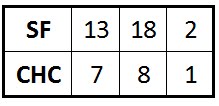
6/28/11 San Francisco Giants 13, Chicago Cubs 7

Wrigley Field, Chicago, IL
Game 1 of 4
First game of Day/Night Doubleheader

Say goodbye to Doug Davis. I mean it, this time. There he goes…

Baseball is a very circular game. I mean this not in the sense that a baseball is kind of circular, or in the sense that the cross-section of a bat is circular, or any of that really. I mean this in an abstract sense...I almost used a $20 word like ‘metaphysical’ but I really don’t think it applies, and I don’t want to overstate what is really nothing but circumstance and coincidence on balls in play. There are many events in baseball that occur where some events, well…come around full circle. It may take decades, years, months, or days. It may require a 15,000 foot view or 15,000 data points to observe. Or, it may be as plain as the nose on your face. Sometimes you can see all of these peculiar baseball circles, intersecting and overlaying. Circles have a non-descript beginning and ending, we can’t really tell for sure where that point exactly is…but we know it’s there.


The circle began when today’s game was really supposed to be the 3rd game of a 3-game series that was played here in Wrigley on May 15. Game 2 of that series featured a semi-historic outing by Giants starting pitcher Ryan Vogelsong as he faced opposing starting pitcher Doug Davis in his very first appearance as a Cub. That contest was called after 6 innings due to rain, the final game of the series was postponed due to continued inclement weather. As it usually happens, the game was indeed rescheduled to occur when the Giants returned to Chicago at the end of June, hence the Day/Night Doubleheader.

Here’s where circumstance and coincidence come into play; Vogelsong and Davis are both facing each other once more. Vogelsong is not as efficient (nor does he face the same defensive quandary as he did on 5/14, when the weather was effectively playing both teams for the title!) but Davis is pretty much as consistent…Vogelsong gives up 6 runs (5 earned) on 6 hits in 5 innings, 4BB, 6K and 2 HR. Davis, sigh, works for only 4.1 innings, allowing 10 runs (all earned) on 12 hits, 3BB, 3K and 1 HR.

On 6/29/11, the following day, the Cubs release Doug Davis. He signs with the Chicago White Sox on July 15, appearing in 9 games with AAA Charlotte Knights (including this admirable outing against the Louisville Bats on 7/23/11) until he was released on September 4.

The Cubs are, then, firmly routed by the Giants, but a Cub fan makes a humorous turn on a Home Run trot by Miguel Tejada in the 9th. It’s well-known that when you are in the bleachers at Wrigley and the opposing team hits a Home Run, you should throw the ball back on to the field. It’s a turd, really…don’t keep it, throw it back! You may think this is silly, and you are entitled to think this, but it’s not just a corny thing some people do, it’s something Cub fans do to show their respect, and there really is nothing stupid or silly about it…and that’s MY opinion about that.

Of course, it’s also true that lots of fans in the bleachers do have ‘alternative balls’ that they will throw back onto the field instead of the ‘actual’ ball…I would never do this, but I would support any fan’s doing so as, once again, it still serves to demonstrate the respect we have for our own team’s Home Runs, as opposed to the disrespect we have for the opposing team’s Home Runs.

It’s clear in this instance, that this fan is not switching any baseballs, and it’s also clear that as Tejada’s tater lands squarely in his hands, he knows well before the catch what he’s going to do with it. And he does it very well, with a formidable gold glove-caliber outfield assist throw that finds the ball actually beating Tejada back to the plate. Somebody sign this guy!!

The Doug Davis Cubs circle began with a game against Ryan Vogelsong and the Giants, who were victorious, the circle ends with a game against Ryan Vogelsong and the Giants, in a makeup of what was to be the final game of the original series. Baseball is weird like that, very circular at times.


If you enjoy my work, I encourage you to spread the word via Twitter
(I am @yoshiki89), and also please leave a comment!
Related Posts Plugin for WordPress, Blogger...